Letter No. 29 · Thursday, the first of October · A fourteen minute read
Dear Diary
A letter on the discard pile, and how to read it
My Fellow Table Guests,
October has arrived at the table, and Prim would like to open the month by asking you to look somewhere you almost never look. Not at your rack. Not at the card. At the middle.
Every tile your table has given up this afternoon is lying there, faceup, in plain sight. The leftovers from the Charleston that nobody wanted. The early winds thrown without a second thought. The Five Dot somebody held far longer than was comfortable before she finally let it go. Most players glance at that pile only long enough to see whether the newest tile is one they can call, and then their eyes go straight back to their own tiles, where they stay.
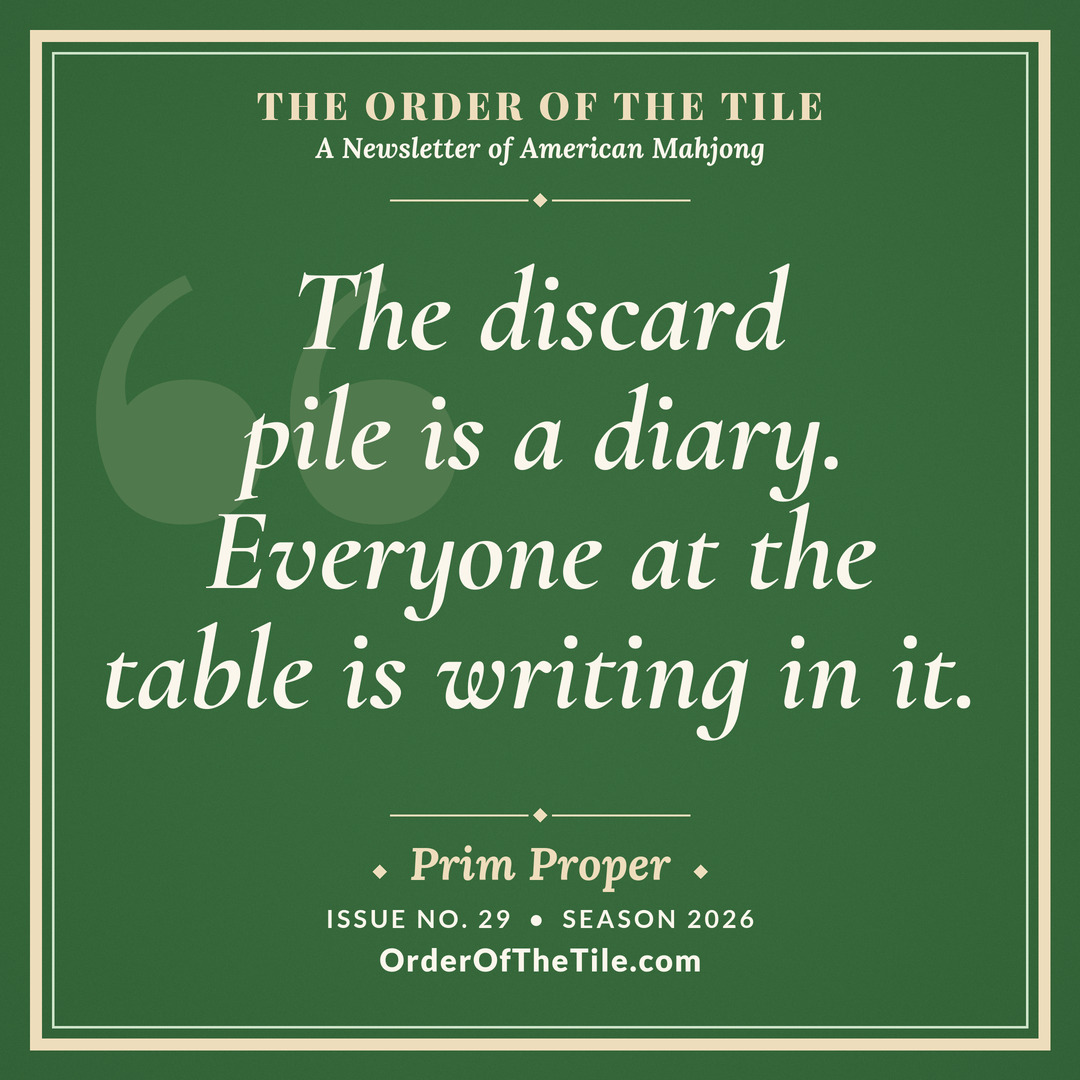
Prim would like to suggest that the pile is not a pile at all. The discard pile is a diary. Everyone at the table is writing in it. Each entry is signed by whoever threw it, and it may be the most honest document in the room, because nobody writes in it to impress anyone. Your own rack can only tell you what you are hoping for. The middle of the table tells you what has already happened, and what has already happened is very nearly always the more useful news. So this week, Prim would like to teach you to read it.
~Prim
The Draw
How she always seems to know
There is a question that surfaces in the groups every few weeks, usually from a player who has just lost a hand she was sure was hers. How did she know? The woman across the table held the very tile she needed for most of the afternoon, then let it go the moment it could no longer help anybody. Or she found a safe discard, turn after turn, as though she could see straight through the backs of the tiles. The replies arrive quickly and they are lovely. She has been playing for forty years. She has a sixth sense. Some people are simply born with it.
Prim adores a legend, and she would like to retire this one gently, because it keeps good players from becoming better ones. The woman who always seems to know is not reading minds. She is reading the middle, where every other player at the table has been setting down, one tile at a time, exactly what she does not need. Forty years help, of course, but only because forty years is a great many afternoons spent looking at the same place. The looking is the skill. The years are simply how long she has been doing it.
And here is why Prim is starting the month on it. The legend makes this sound like a gift you either received at birth or did not, and it is nothing of the kind. It is a habit, and a habit can be started this week by anyone willing to lift her eyes from her own tiles for three seconds a turn. So the next time a thread asks how she always knows, Prim hopes somebody gives the answer that is both true and encouraging. She looked. You can too.
Crak the Card
Counting what is gone, and what it rules out
A diary is only useful to someone who reads it closely, and the discard pile rewards a particular kind of closeness, which is counting. Prim does not mean memorizing every tile of the afternoon. Nobody at your table is doing that, whatever it looks like from your chair. She means knowing which few facts in the middle quietly close doors on the card, for you and for everyone else.
Every tile comes in fours, so the pile is arithmetic.
Apart from the flowers and the jokers, there are exactly four of every tile in the set. That one fact turns the discards into a ledger. Suppose three Six Craks are already showing, in the pile and in someone’s exposure, and you hold none. Only one Six Crak is left anywhere in the game, and jokers never stand in a pair, so no one at your table can finish a line that needs a pair of Six Craks, and a line that needs it as a single belongs only to whoever holds that very last tile. Any hand on your card built on that pair is closed, to you and to the three people you are playing against. A pung is another matter, because jokers may fill a group of three or more, so do not read more into the count than it says. But the pairs and the singles are where the arithmetic is merciless, and they are exactly where most players never think to look.
Read what she lets go early, and notice what she never lets go.
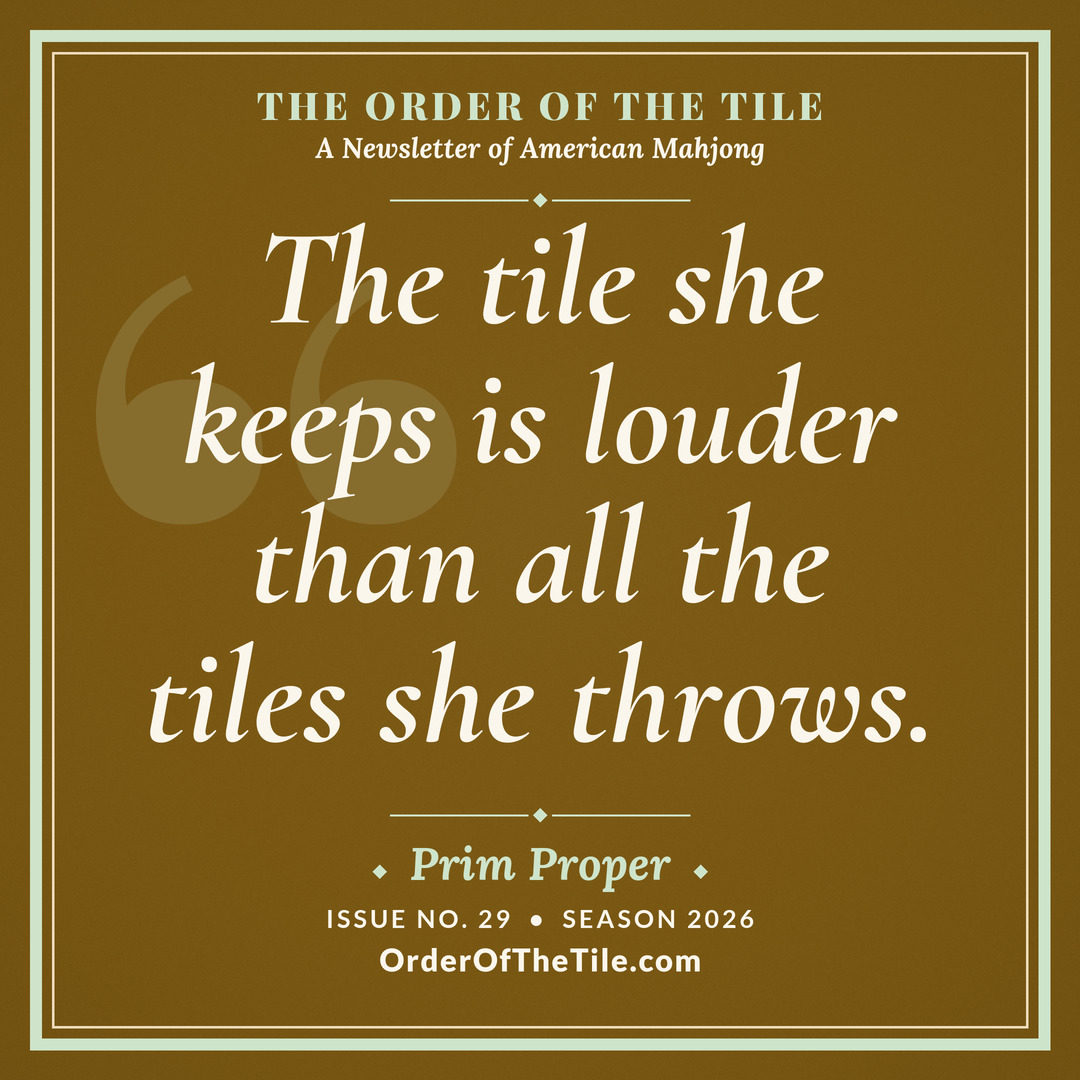
A player who throws winds in the first few turns is almost certainly not building a winds hand. A player who sends off evens early is telling you, without meaning to, which neighborhood of the card she has left. That much most people know. The subtler entry in the diary is the absence. Watch for the suit that one player simply never parts with, round after round, while everything else goes by. The tile she keeps is louder than all the tiles she throws. Put that silence beside her first exposure and a card of dozens of lines narrows, quite quickly, to two or three, and at that point you are no longer guessing at her hand. You are reading it. If you would like to practice this exact habit before your next game, Prim keeps The 2026 Card Challenge Workbook: Reading and Defense beside her own set, sixty three drills that ask you to read the player across from you first, count what is already out, and only then decide what to throw.
Only the newest entry can be claimed. Every older one is still worth reading.
The moment the next tile lands on top of a discard, that discard can no longer be called by anyone. So nearly all of the pile is closed for claiming, and nearly all of it is wide open for reading, which is the part so many players forget. The deep layers of the pile are where the defense lives. A tile that has already gone by twice with nobody calling it is, as a rule, a kinder discard than one nobody has seen all afternoon. A joker is the kindest of all, because a discarded joker may never be claimed. None of these is a guarantee, and Prim would never sell you one. But the player who reads the whole pile before she lets a tile go is not playing more cautiously than you. She is simply playing with more of the facts.
The Table Is Asking
May you look back through the pile, and how much of it may you say out loud?
The question came in two parts, the way the good ones do, and the second part was the one that had been keeping her up. She had started, this season, glancing back through the discards before she threw, and one afternoon a tablemate asked her, not unkindly, if that was allowed. She was not sure. And then, a few hands later, when a friend reached for a tile, she heard herself say that three of those were already out, and the whole table went a little quiet, and she has been wondering ever since if she helped or overstepped.
Prim will take the first part plainly, because it has a plain answer. Yes, you may look. The discards sit faceup in the center precisely so that every player can see them, and Prim went looking through the rules she keeps closest for any line forbidding a player to read what is already public, and found none. What you should not do is touch. Keep your hands off the pile, never sort it or tidy it or dig a tile out to check it, because a hand in the discards invites everyone to wonder if you are claiming, and at a tournament the tile you touch is very often ruled yours. Read with your eyes. The diary is open to everyone, and it stays exactly where the table wrote it.
The second part is where manners come in, and Prim will be just as clear. What you see in the pile is yours to use. It is not yours to announce. Tom Sloper, whose rules pages have answered this sort of thing for decades, puts it about as well as it can be put: there is no rule against giving information at the American table, but it is in bad form to reveal anything about another player’s hand while the game is on. Saying that three Six Craks are gone sounds like simple arithmetic, and it is, but said aloud it does a friend’s reading for her and quietly tells the table which tile somebody has been waiting on. So count to yourself, and let everyone keep her own diary. And give yourself grace for that quiet afternoon, because you meant it as help. At a teaching table, where someone new has asked to be walked through, saying it out loud is a lovely gift, between hands and with her permission. At a playing table, the kindest thing is silence.

Now Prim would like to hear from you. Where do you stand? Are eyes on the pile welcome at your table, and hands kept out of it? Would you like to be coached, and if so, when? Bring it up at your next game and settle it in good humor before anybody needs it. Then tell Prim where you landed on Saturday, when this very question comes to Instagram and Facebook. And because a table never runs out of questions, this week Prim also settled what it means to rack a tile, and why it matters, if you may switch to a different hand after you have exposed and whether you may call a discard to make a pair.
Who’s Talking
The man who took the card away and found the defense still standing
Prim wanted someone this week who had tested this letter’s idea harder than anyone, and she found him in an unexpected place. His name is John Burton. He is an independent game designer, and he set himself a puzzle that Prim finds rather wonderful. Keep the American rules and the American tiles, take away the card of hands altogether, and see what is left of the game. What he built is called Card Free American Mah Jongg, and it runs on a short set of rules about how numbers and suits may be grouped, in place of a printed list.
He tells you where the idea came from with a designer’s honesty. He loved the play of the American game, and he borrowed ideas from the Hong Kong, Sichuan and Japanese styles to build something new on top of it. He playtested it with real players and has been writing up what he learned, and one of those notes stopped Prim in her tracks. Experienced American players, he found, were asking a fair and worried question. Without a card, with no list of hands to measure a rack against, how could anyone possibly play defense?
His answer, in a post cheerfully titled “Defense? Yes you can!”, is the heart of why he is in this letter. You play defense the same way you always did, he explains, by reading the exposures and the discards. A joker is always safe to throw. An exposure tells you which numbers sit close to it and are therefore dangerous, and which sit far away and are therefore safer. He even works out that in his system a number two steps from an exposure is the most dangerous of all, because it could belong to more than one kind of group. By the second exposure, he writes, a careful reader can work out much of the set, and by the third, usually the whole pattern.
Prim plays the League’s card, as most of you do, and she has no intention of putting it down. But she loves this experiment because it proves her point from the other side of the table. Take the card away entirely and the defense survives, because the defense was never on the card. It always lived out in the open, in the discards and on the tops of the other racks, in what had already been shown. He did not set out to prove that about the American game, and he proved it anyway. You will find his rules and his notes at cardfreemahj.com.
Tile Envy
Where the diary is kept
Every serious table has had a great deal of thought lavished on it. The tiles are chosen with care, the racks match, the mat was debated for weeks, the pushers have opinions. And in the very middle of all that loveliness sits the one patch of the table almost nobody designs for, which is the space where the discards go. Prim will make the case, this week of all weeks, that it deserves the most thought of all, because it is where the only story in the room that is actually being written gets written.
The first thing a beautiful middle needs is quiet. A mat with its busiest artwork right at the center is a gorgeous object and a difficult page to read, because the tiles have to compete with the pattern beneath them. The mats Prim covets for this week’s purpose put their drama at the borders and leave the middle calm, a soft field where a faceup tile sits clearly on its own. And the tiles themselves matter just as much. The Mahjong Line, the house Annie O’Grady and Kate LaGere built, says outright that it chooses its colors “to improve a quick scan of the table,” and Prim finds that a rather elegant thing for a tile maker to admit. It is a design choice made for the reader. A pile of their tiles, with each suit in its own clear color, reads at a glance from across the room, and that is a kind of beauty that earns its keep every single turn.
And then there is the shape of the pile, which is not decoration at all. Tiles laid flat and faceup, each one visible, in the shared middle, make a pile that anyone can read fairly. Tiles tossed onto one another make a heap where half the entries are hidden. Tiles kept in a tidy little row in front of one player’s own rack make, as the old rules columns have noted, an easy record of exactly what she has thrown, which is generous of her and rarely what she intended. Prim’s preference, for looks and for fairness together, is a calm middle, clear tiles, and a pile that lies flat. A diary should be kept somewhere you can actually read it.
Set Your Rack
Twenty four games of discards in a single Sunday
This week the spotlight goes to a day with more reading in it than most. On Sunday, October 11, Mah Jongg Mania holds a six round tournament at the Best Western Premier in Plainview, on Long Island, from ten in the morning to half past four. Six rounds of four games each is twenty four games in a day, against a new set of opponents at every rotation, and Prim cannot think of a better place to practice everything in this letter. Twenty four fresh diaries, each written by strangers, each one closed and gone at the end of fifty minutes.
The day is run by Michele and Lori, two Long Island players who have been friends since kindergarten and who started these tournaments for exactly the player Prim hopes is reading this: someone who loves the competition but finds a full weekend event too much to take on. Seats and positions are assigned at random, the rules and scoring are emailed to every player ahead of time and set out on the tables, each round is four games in fifty minutes, and East keeps score for the table. There are cash prizes for the highest scores of the day, the top score in each round, and the hand of the day. Coffee, tea and light refreshments run all day, and dessert comes after lunch, which you bring yourself.
And if you have never played a tournament and the clock is the part that worries you, they have thought of you too. The Sunday before, October 4, they run a Boot Camp at the same hotel, an afternoon for players who already know the game and want tournament rules, etiquette and scoring explained before they sit down for real. Details for both are on their site, mahjonggmania.net, and questions go to [email protected].
And one line on the summit, now a fortnight away. The eleventh Mah Jongg World Championship gathers October 16 to 18 at Paris Las Vegas, it is sold out to a waitlist, and Prim will write about it properly once there is something to report.
Upcoming events
- OpenMah Jongg Mania six round tournament (Sunday, October 11, Best Western Premier, Plainview, New York, 10 AM to 4:30 PM)
- OpenMah Jongg Mania Boot Camp for new tournament players (Sunday, October 4, Best Western Premier, Plainview, New York, 12:30 to 4:30 PM)
- OpenSecond Annual MAHJ-O-RAMA, hosted by Mah Jongg Maven (Sunday, October 11, Congregation Dor Tamid, Johns Creek, Georgia, five rounds, $70 with lunch)
- Sold OutMah Jongg World Championship (October 16 to 18, Paris Las Vegas, waitlist only)
Crak Intelligence
Where “reading the wall” comes from, as best anyone can tell
Here is a small puzzle to carry to your next game. Players have said for years that a sharp opponent is “reading the wall,” so Prim set out to find the first person who said it. She could not find one. The phrase has no inventor anybody can name. But it has three ancestors, and they are much more interesting than an inventor would have been.
The first is the wall itself, the one you build. At the American table each player stacks nineteen tiles, two high, facedown, and the four rows together make the wall that every hand is drawn from. Which means, strictly speaking, that nobody can read the wall. It is the one part of the table that is hidden from everyone. A good player reads everything that has left it, and from that she works out what must still be inside. The second ancestor comes from Japan. In the Japanese game there is a defensive idea called kabe, which simply means wall. When all four copies of a tile are visible, the players say a wall has formed, because certain groups that need that tile have become impossible, and the tiles around it are safer to throw. Safer, the Japanese teachers are careful to add, is not the same as safe. It is the very counting in this week’s Crak the Card, with a proper name.

The third ancestor is the oldest, and Prim’s favorite. The phrase the writing on the wall comes from the Book of Daniel, from the feast of King Belshazzar, where a hand appears and writes four mysterious words on the palace wall. Not one of the king’s wise men can read them. Daniel can. And the first word, mene, means numbered. The second, tekel, means weighed. Scholars add that the words are also measures of weight and money, a mina, a shekel, a half. So the most famous wall in literature was, when you finally read it, a piece of counting and weighing, legible only to the one person in the room who had learned how. Prim finds that almost too tidy to be true, and it is true anyway. The wall has always known. Now so do you.
The Weekly Challenge
Seven racks. Your call. Then Prim’s.
Seven new problems from the table, every Thursday, for readers of this letter. You make your call, you tell Prim why, and only then does she tell you how she would play it. Here is the first of this week’s seven. The other six are waiting for you on the site all week, until the next set opens.


First Charleston, first pass, and it goes to the right. Three tiles leave your rack. Which three?
- South, West and the Five Dot
- The Seven, Eight and Nine Crak
- Two Green Dragons and the Five Dot
No answer here on purpose. Make your call on the site, write a line about why, and Prim answers you there. Your letter email is your key; no password, ever.
Make your callAnswer all seven before next Thursday and your name goes in the month’s pot, once for every set you finish. One reader is drawn each month for a Practice Workbook of her choice.
A Closing Note
It is the twenty ninth letter, and the first of October, and Prim has spent it asking you to lift your eyes.
The tiles in front of you will always feel like the most important ones at the table, because they are yours. But the story of the hand is being written a little further away, in a place everyone can see and almost nobody reads. Read it. Keep what you learn to yourself. And the next time somebody at your table asks how you always seem to know, smile, and tell her it was never a secret.
Prim may write for the women at the table, but she firmly believes everyone is welcome. Everyone deserves a seat at this table.
Don’t tap it, rack it, double stack it. Do it to it, don’t construe it. We all know that Prim won’t skew it. The Order of the Tile, pursue it.
Until next week, may your rack be blessed and your Charleston ruthless.Prim, as always
Forward this to your favorite fourth.
Everyone deserves a seat at this table.
Prim Shows Her Work
Every name, number, and event in this letter, with the receipts.
Show the sourcesHide the sources
- Four of every suit, wind and dragon tile, eight flowers and eight jokers, and the wall built nineteen tiles long and two high
- Jokers may never represent tiles in single and pair groupings, only groups of three or more, from the American Mah Jongg Association rulebook
- A covered discard becomes a dead tile, a discard must be named before it is claimed, and a discarded joker may never be claimed
- A tile cannot be called once it is covered by the next player in turn, Mah Jongg Fever rules
- If you touch the tile it is yours, and please do not criticize or judge your opponent’s play, Destination Mah Jongg rules
- No rule against giving information, but in bad form to reveal another player’s hand, and the record left by discards kept in front of your own rack
- Discards as clues to a player’s hand, a wind thrown early and a six thrown early
- John Burton, independent game designer, and why he built Card Free American Mah Jongg
- Defense? Yes you can!, reading exposures and discards with no card of hands
- The Mahjong Line uses color to improve a quick scan of the table
- The Mahjong Line, founded by Annie O’Grady and Kate LaGere
- A mat sized to keep the shared discard pile clearly in the middle
- Mah Jongg Mania, Michele and Lori, six round tournaments at the Best Western Premier in Plainview
- Mah Jongg Mania calendar, the October 11 six round tournament and the October 4 Boot Camp
- Second Annual MAHJ-O-RAMA, October 11 2026, Johns Creek, Georgia
- The eleventh Mah Jongg World Championship, October 16 to 18 2026 at Paris Las Vegas, sold out to a waitlist
- Kabe, the wall, and no chance when all four copies are visible
- Belshazzar’s feast, mene numbered, tekel weighed, and the words as weights of money
- What the writing on the wall in the Book of Daniel really means, and why only Daniel could read it
- The 2026 Card Challenge Workbook: Reading and Defense
- What does it mean to rack a tile
- Can I switch to a different hand after I have exposed
- Can I call a discard to make a pair